
By Shawn Corcoran
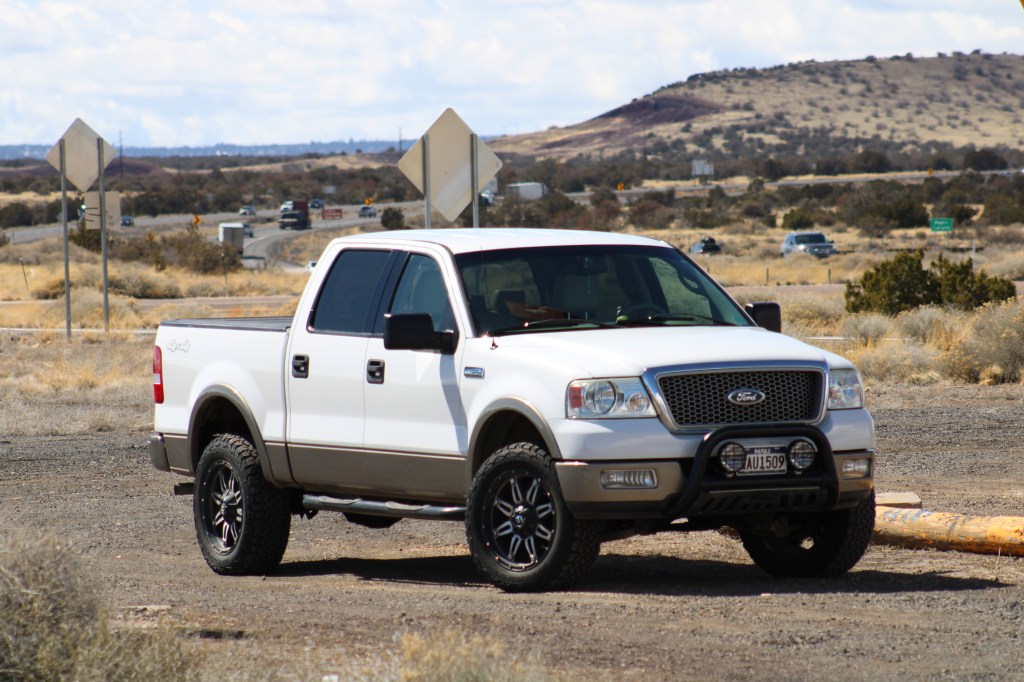
In the world of full-size pickup trucks, one reigns supreme: the Ford F-Series. For over four decades, the F-Series has been America’s best-selling vehicle. Some outside of the United States may wonder how such a large and seemingly simple vehicle remains so popular, but since the late ‘90s trucks have become well-adjusted family cars.
That story started in 1994, with the second generation Dodge Ram pickup, which used semi-truck inspired design language and a movie about tornadoes to turn their pickup from a boxy utilitarian tool, to something that could be used as a status symbol. Ford took a different approach with their 10th generation F-Series trucks, going for a softer, rounder more Taurus-like feel. But the 11th generation F-150, introduced for the 2004 model year, took it a step up, and established the formula Ford has stuck with for over two decades.
Thinking of buying an 11th generation F-150? Well, I have owned a 2004 Ford F-150 Lariat 4×4 SuperCrew for 7 years now. I have had this truck through everything, rain, sleet, snow, road trips, towing adventures and off-road excursions, so here’s what it’s like.
The Powertrain
The 2004 F-150 Lariat is powered by the infamous 3-valve 5.4L Triton V8, paired to Ford’s 4R75E four-speed automatic transmission, putting out 300 horsepower, and 365 pound-feet of torque. With that power, the truck makes the sprint from0-60 in 9.9 seconds according to Motor Week back in the day. It’s not fast by modern truck standards, but it has more than enough power to stay out of its own way.
While the power delivery is good, the 5.4 Triton has a far from ideal reputation. One of the main reasons is spark plugs. Earlier two-valve versions of the engine utilized normal spark plugs, same as nearly every other car ever made. But when it came to making the 3-valve version, Ford switched to a new 2-piece spark plug design.
This was due to Ford wanting to have a longer shank on the spark plug, to better position the spark in the combustion chamber, while also simplifying production of the plugs themselves. This caused a few issues, one of which was that the plugs are more susceptible to carbon build up, from normal engine operation. And fewer threads on the spark plugs have caused them to be known for ejecting themselves out of the engine.
They can also just break in half in the cylinder head just by looking at them funny. This is an especially large risk whenever you go about replacing them. There are tips and tricks to getting them out without breaking half of the plug off, but chances are you will have to shell out $125 for the special extractor tool.
The four-speed transmission is a perfectly fine experience. It shifts smoothly for a four-speed, and moves the over 2.5 ton truck quite well.
Fuel Economy
It should come as no surprise that the old truck is not eco-friendly. The four-wheel-drive models with the 5.4L were originally rated at 13mpg city, 17mpg highway, and 14mpg combined. In my own experience, anything over 13mpg combined feels like a little miracle.
Exterior
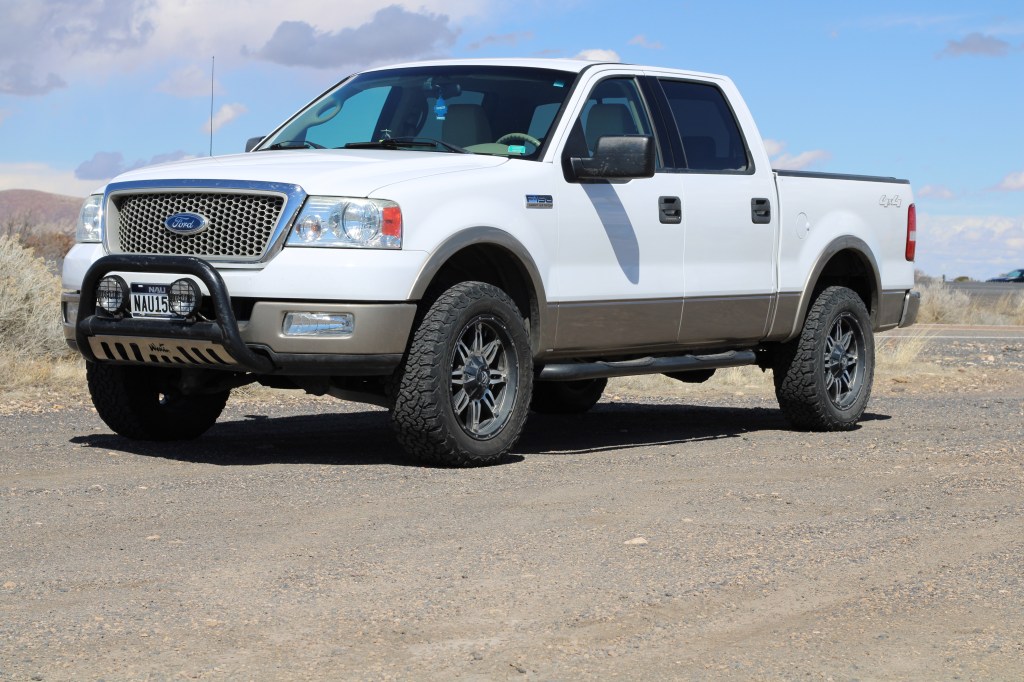
The exterior styling is, in my opinion, a big step up from the previous F-150. The shape is a bit more square, and it looks a bit more rugged than the previous model. Although it does that without looking as messy or busy as most modern pickups. It is the right balance of rugged, and clean.
The Lariat trim gets you a few added exterior details, including 2-tone paint and chrome accents which add to the truck’s already good looks.
Interior
The interior is a surprisingly nice place. The beige base color is broken up with silver and chrome trim, as well as wood accents from the finest of plastic trees. Most of the interior is plastic, although it feels like it is good quality. However, there are more soft-to-the-touch materials on the arm rests and the center console.
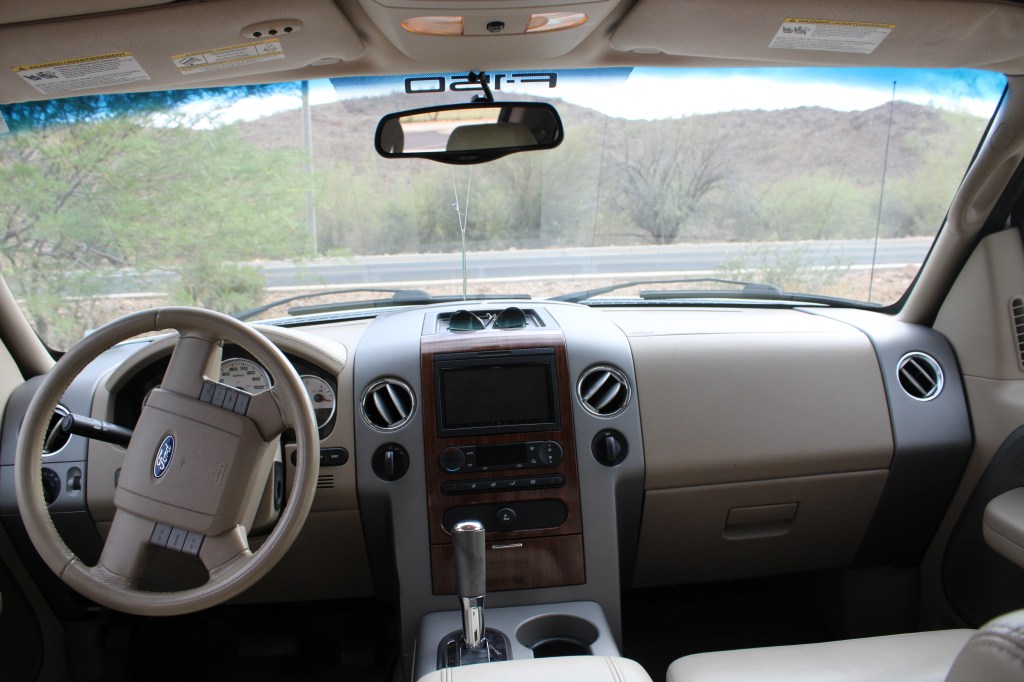
Interior room is abundant, both front and rear seat occupants will find no shortage of leg and head room. The seats are also comfortable, even over long journeys. Bolstering could be better, but it is there more than most other trucks.
The cupholder situation gets a little less convenient. Front-seat occupants get two reasonably placed cupholders in the center console. The backseat occupants get two cup holders that are on the back of the center console. This means they can still be used if you have three people in the rear seat, but only two of them get a cupholder, which is placed directly behind the elbows of the fron seat occupants.
Driving Experience
If there is any one thing that separates the 11th generation F-150 from other trucks of the same period, it would be the driving experience. The interior is quiet, and the ride is smooth, maybe not Mercedes smooth but you get the point.
The truck also has a tight turning radius, which makes the large truck surprisingly maneuverable. This is especially handy in parking lots and residential neighborhoods. This all makes for a truck that is surprisingly car-like in its nature, and makes it feel like it doesn’t lag too far behind its modern counterparts.
Off-Road
Don’t be mistaken, this is no Raptor, that model wouldn’t make its debut until the 12th generation F-150. There are no G.O.A.T. modes, to be found, and the terrain management system is better known as “your right foot.” The truck does feature both 4-Hi and 4-Lo, which gives it some proper ability on the trail. It is also conveniently operated with a switch on the dashboard, and you can switch from 2-Hi to 4-Hi on the fly (up to 55 mph).
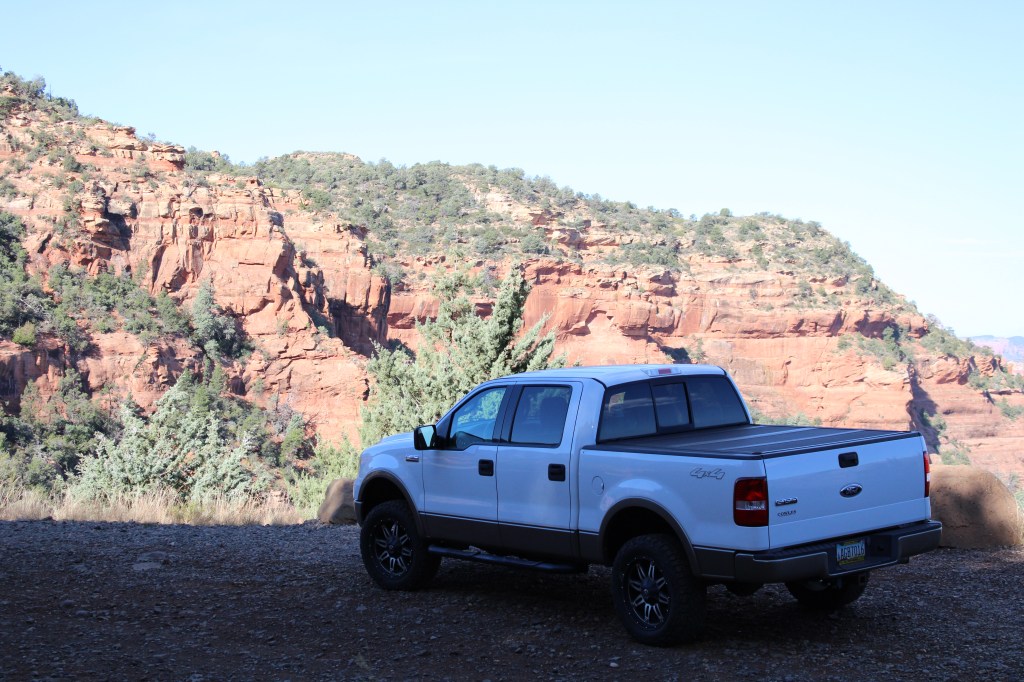
There is also decent ground clearance, about 8.3 inches from factory. You also get a durable solid rear axle, with independent front suspension setup. What hurts the truck on the trail is its size. The long wheelbase makes for a less than stellar break-over angle, and the wide body will make some trails feel a bit tight. The tall stature also takes away from visibility, making it tough to see obstacles in front of you.
In adverse weather conditions, the truck has been phenomenal. It has served as a trusty form of transportation through several blizzards, handling the low temperatures and poor road conditions without fault.
Truck Stuff
So how does it handle actual truck stuff? Not the stuff you see in the ad, but the real work. Well it is about average. This is before companies started doing fancy tricks, with stair cases and step ladders that fold out of the tailgate, or on board power systems. It is rather basic overall, you do get four tie-down points to secure your load, but that’s about it.
The short 5.5 foot bed will leave some wishing for more room, as it makes it difficult to haul many larger items. However, that issue can be found on most trucks with a full four-door cab. Plus, with a payload of up to 1,690 pounds you have plenty of utility to use.
As for towing, the 2004 F-150 has performed surprisingly well for a 22-year-old truck. I most recently used it to tow my old 4Runner back to Phoenix, and the F-150 was still able to accelerate and stop well. Long uphill interstate sections were not the easiest, but it made for a smooth trip.
In the end, the 11th generation Ford F-150 is a fine truck. It is surprisingly comfortable on-road, even by today’s standards, and easily fits in today’s world. There are some reliability concerns, namely that little issue with the two-piece spark plugs. It is also far from efficient, so don’t expect to save money on fuel.
However, with modern truck prices as high as they are, it is reasonable that many people are looking at used trucks. The 11th generation F-150 is on the older side of what most people go for in used cars these days. However, for the era, it is surprisingly modern and capable in today’s world.


Leave a comment